
Artificial intelligence is transforming how modern enterprises compete, decide, and grow. Yet many still struggle to connect bold ideas with measurable outcomes. That’s where AI Strategy Consulting comes in—turning complex data into clear direction. In this guide, you’ll discover how to build an AI strategy that not only adapts to change but actually delivers results worth celebrating.
Table of Contents
What Is AI Strategy Consulting and Why It Matters
In today’s digital economy, AI Strategy Consulting has become one of the most critical enablers of business transformation. Organizations that once relied solely on traditional market data now use artificial intelligence to make faster, more informed decisions. AI consultants act as the bridge between technology potential and business reality—helping executives identify where AI creates the most strategic impact and how to deploy it responsibly.
Recent analyses from leading consultancies suggest that companies investing in AI strategy outperform peers in efficiency and adaptability. By integrating data-driven insights into decision-making, businesses can anticipate trends, personalize services, and optimize operations at scale.
The Evolving Role of Artificial Intelligence in Business Decision-Making
Artificial intelligence is no longer a futuristic concept—it’s a practical tool that empowers leadership teams to replace intuition with evidence-based strategy. From predictive analytics in finance to demand forecasting in retail, AI applications have matured into measurable business drivers. Yet success rarely happens by accident. It requires a structured roadmap developed through AI Strategy Consulting that aligns algorithms with enterprise goals and governance standards.
Why Traditional Business Strategies Fall Short Without AI
Traditional strategy models often rely on static data and backward-looking analysis. In contrast, AI enables continuous learning through real-time data streams. Without AI, decision cycles slow down, forecasts become less accurate, and competitive advantages fade. That’s why many firms now partner with AI consulting services to modernize their decision frameworks and stay ahead of disruption.
Understanding the Pillars of an Effective AI Strategy
An AI strategy is only as strong as the foundation it’s built on. Successful organizations focus on three pillars: vision, data, and execution. Vision defines the strategic purpose of AI, data provides the raw material for intelligence, and execution transforms that intelligence into measurable results.
Vision: Setting the Strategic Direction
A clear vision identifies how AI supports the company’s mission. It establishes priority areas—customer experience, risk management, or supply chain optimization—and ensures alignment across departments. AI business strategy experts often begin by conducting stakeholder workshops to define a shared purpose before any technology investment begins.
Data: The Lifeblood of AI Decision Systems
Quality data determines whether AI initiatives succeed or fail. Companies must audit their data pipelines, governance practices, and compliance frameworks. According to research from major advisory firms, organizations that adopt strong data-governance models experience up to 40% faster ROI on AI initiatives. These insights demonstrate why early AI readiness assessments are so valuable before large-scale implementation.
Execution: Turning Strategy into Measurable Outcomes
Execution transforms theoretical models into tangible business impact. Here, AI Strategy Consulting plays a pivotal role—mapping each initiative to KPIs, budgets, and resource plans. Consultants also help define ethical guidelines to ensure transparency and accountability in automated decisions.
Assessing AI Readiness: Laying the Foundation for Success
Before deploying algorithms or selecting tools, every enterprise should measure its readiness for AI adoption. This assessment includes technical, cultural, and leadership dimensions. A readiness evaluation uncovers gaps in infrastructure, data maturity, and skills that might otherwise derail projects later.
Conducting a Comprehensive AI Readiness Assessment
Begin with a structured review of current analytics capabilities, data quality, and process automation. Identify where manual decision-making slows performance and where AI could generate efficiency. Many companies use standardized frameworks from professional institutes or external advisors to benchmark their AI maturity level.
Evaluating Data Infrastructure and Governance Practices
Strong governance ensures that AI models operate on reliable, unbiased data. According to reports from global technology leaders, governance maturity directly correlates with model accuracy and ethical compliance. Firms implementing enterprise data catalogs and lineage tracking systems achieve more trustworthy AI outcomes. Consulting teams can recommend advanced tools such as secure cloud environments and automated data-validation workflows to support these standards.
Organizational Culture and Change Management Considerations
Technology adoption is only half the battle—people drive success. Leadership must communicate how AI enhances rather than replaces human judgment. A culture of collaboration, continuous learning, and cross-functional communication prepares employees for the shift toward AI-assisted work. Partnering with experienced AI consultants often accelerates this cultural transition by providing training programs and change-management frameworks.
Building Your AI Roadmap: From Vision to Execution
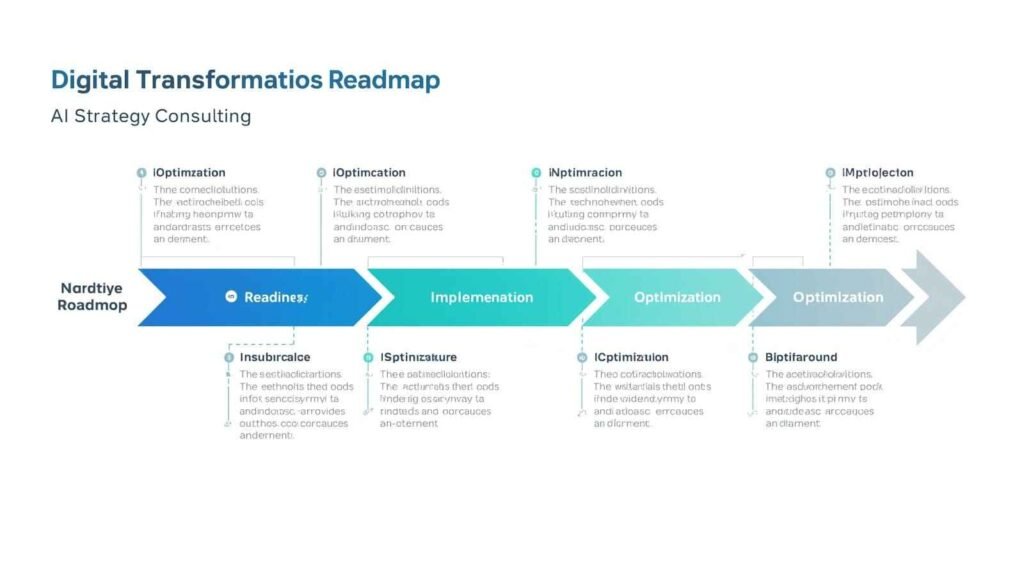
Once readiness is established, the next step is creating an actionable roadmap. This document connects the organization’s mission with achievable AI initiatives and timelines. It defines use cases, resource allocation, governance checkpoints, and communication plans. By collaborating with AI implementation specialists, companies can translate strategic intent into operational momentum.
Part two of this article will explore how to identify high-value AI use cases, select the right tools, and engage consulting partners effectively to deliver measurable results.
Identifying High-Value AI Use Cases Across Departments
Once an organization’s AI readiness is validated, the next challenge is to identify where AI can drive the most measurable impact. Not every department benefits equally from automation, so focus and prioritization are essential. AI Strategy Consulting firms typically begin by mapping business pain points against data availability and potential ROI.
For example, in marketing, AI improves customer segmentation and personalization; in finance, it refines credit scoring and fraud detection; and in supply chain management, predictive models optimize logistics and inventory. The key is to start with a few focused use cases that yield quick wins while building internal confidence and capability.
Prioritizing Initiatives Based on Feasibility and Impact
Consultants often use a “feasibility–impact matrix” to evaluate and rank potential AI projects. This method helps executives choose initiatives that are technically achievable yet strategically significant. According to a recent analysis by a global research firm, organizations that balance technical feasibility with strategic impact are 60% more likely to scale AI successfully.
Choosing the Right AI Tools and Platforms for Implementation

Tool selection plays a major role in execution success. Businesses should evaluate whether open-source frameworks, cloud-based services, or proprietary enterprise platforms best suit their needs. Factors such as scalability, integration capability, and data security must guide the decision.
Among the leading AI tool providers, platforms like Google Cloud AI, Microsoft Azure Machine Learning, and IBM Watson are frequently cited for enterprise-grade reliability. When combined with expert consulting support, these tools enable faster prototyping, improved model accuracy, and seamless deployment across business units.
To further explore implementation considerations, see our related resource on AI Tools for Business Strategy.
The Role of AI Strategy Consulting Firms in Transformation
AI Strategy Consulting firms act as catalysts, accelerating adoption by bringing structured methodologies, multidisciplinary expertise, and deep domain knowledge. Their work spans from strategic visioning to hands-on implementation support, ensuring that AI investments generate sustainable value.
What AI Consultants Bring to the Table
Consultants integrate business acumen with data science. They analyze internal processes, assess model performance, and guide leadership teams in decision-making. Leading research suggests that organizations engaging external AI consultants experience higher project success rates and faster time-to-value due to specialized skill sets and proven frameworks.
How to Select a Reliable AI Strategy Consulting Partner
Selecting the right partner requires evaluating technical depth, industry experience, and transparency of methodology. Trusted advisors typically follow a “co-create and transfer” approach—building models alongside internal teams and transferring knowledge for long-term independence. A detailed checklist for choosing such partners is available in Top AI Consulting Firms.
Evaluating Costs, Deliverables, and Long-Term Value
While consulting engagements may seem costly upfront, they often reduce long-term expenditure by preventing failed projects and inefficient resource use. The best AI consulting firms emphasize measurable deliverables—ROI improvement, customer retention, operational efficiency—and maintain transparency through data-backed reporting.
Designing a Scalable and Ethical AI Framework
Building a scalable and responsible AI system is not only a technical task—it’s a strategic obligation. AI ethics and governance ensure that automated systems act in alignment with organizational values, industry regulations, and public expectations.
Embedding Transparency, Privacy, and Fairness in AI Design
Every algorithm must be explainable and auditable. AI Strategy Consulting experts encourage using interpretable models and documenting decision logic to mitigate bias and regulatory risk. Enterprises that adopt “AI transparency statements” demonstrate accountability to clients and regulators alike.
Regulatory Compliance and Ethical Guardrails
From data protection laws like GDPR to emerging AI Acts, compliance requirements are evolving rapidly. According to advisory insights from global organizations, companies that embed compliance checkpoints early in their AI lifecycle face fewer legal and reputational risks. Partnering with AI consultants familiar with regulatory landscapes helps design systems that respect both innovation and compliance.
Balancing Automation and Human Oversight in Decision-Making
Even the most advanced AI systems require human validation. The goal is to augment—not replace—human expertise. By maintaining human oversight loops, organizations safeguard against unintended consequences and build stakeholder trust.
Implementation in Action: Case Studies and Success Stories
Let’s examine how organizations translate strategy into tangible results through real-world AI applications. These case studies illustrate the role of structured consulting and disciplined execution in achieving sustainable transformation.
Case Study #1: AI-Driven Customer Insights in Retail
A leading retailer collaborated with consultants to integrate predictive analytics into its loyalty programs. Within months, customer retention increased by 25% as AI identified purchasing patterns that manual systems missed. The consulting team used iterative model training and cross-channel integration to deliver lasting insights.
Case Study #2: Predictive Maintenance in Manufacturing
In manufacturing, unplanned downtime can cripple productivity. A global equipment producer used sensor data and machine learning algorithms to forecast component failures. Guided by external advisors, the company achieved a 30% reduction in maintenance costs while improving equipment lifespan.
Case Study #3: AI-Powered Financial Forecasting
In the financial sector, consultants designed AI models that simulate complex market scenarios. These models help executives anticipate volatility, optimize portfolios, and improve credit risk assessments. The project underscored the value of combining quantitative analytics with strategic foresight—two areas where AI Strategy Consulting delivers unmatched value.
To learn more about execution challenges and overcoming barriers, explore our related discussion on AI Implementation Steps.
In the next section, we’ll explore how organizations can measure ROI, avoid common pitfalls, and sustain continuous optimization in their AI strategy.
Measuring Success in AI Strategy Consulting
Every AI initiative must demonstrate measurable business value. The most successful programs treat AI Strategy Consulting not as a one-time investment but as a performance-driven discipline. Measuring outcomes ensures that models remain relevant, accurate, and aligned with evolving business goals.
Defining Key KPIs and Business Impact Metrics
Organizations should establish clear success metrics before implementation begins. Common KPIs include time saved in decision-making, revenue growth from predictive insights, reduced error rates, and customer satisfaction scores. Consultants also help define domain-specific indicators—such as risk reduction in finance or energy efficiency in manufacturing—to quantify the impact of AI solutions.
How to Track ROI and Long-Term Benefits
Unlike traditional projects, AI’s return on investment evolves over time. Early-stage metrics may focus on operational improvements, while mature systems track innovation outcomes and market differentiation. A report by a leading management consultancy revealed that companies using continuous value tracking achieved up to 3x higher ROI compared to static measurement approaches.
For an in-depth view of performance metrics, review our complementary analysis on AI Strategy ROI, which explains quantitative methods for evaluating AI success across industries.
Leveraging Data Feedback Loops for Continuous Optimization
AI models thrive on iteration. Continuous feedback from users, customers, and data sources allows systems to adapt to new patterns and improve accuracy. Modern consultancies emphasize establishing a “learning loop” framework—collecting feedback, retraining models, and revalidating assumptions. This approach converts AI from a project into an evolving capability.
One major enterprise platform reported that automated feedback loops improved model reliability by 20%, while also reducing maintenance time. Through regular audits and optimization cycles, businesses maintain performance even as data complexity grows.
Common Pitfalls in AI Strategy Development
Even with expert guidance, some organizations encounter predictable obstacles when executing their AI strategy. Understanding these pitfalls—and how to avoid them—saves both time and resources.
Misalignment Between Strategy and Execution
A frequent challenge is the gap between strategic ambition and execution capacity. Companies may overestimate technological maturity or underestimate integration complexity. AI readiness assessments mitigate this by clarifying existing capabilities and aligning them with realistic timelines.
Inadequate Data Quality or Model Explainability
AI models are only as strong as the data feeding them. Inconsistent, biased, or incomplete data leads to flawed predictions. Moreover, opaque algorithms can erode stakeholder trust. According to industry analysis from a global research institution, explainable AI (XAI) adoption is rising rapidly, as enterprises demand visibility into algorithmic logic. Regular validation audits and bias-detection protocols should be embedded into every project roadmap.
Ignoring Employee Training and Adoption Barriers
Resistance to change often undermines AI adoption. Teams may feel threatened by automation or unsure how to use new tools effectively. Successful firms counter this through training, communication, and collaborative workshops. Many leverage support from specialized AI consultants to ensure staff engagement and build confidence in AI-driven decisions.
Continuous Optimization and Long-Term Value Creation
After deployment, AI systems must evolve alongside market conditions and customer expectations. Continuous optimization keeps models relevant and performance high. This process involves periodic re-assessment of algorithms, retraining datasets, and incorporating new variables to capture shifting trends.
Creating an AI Governance and Monitoring Framework
Governance plays a pivotal role in sustaining trust. Establishing dedicated AI steering committees ensures accountability and ethical oversight. Reports from technology think tanks emphasize that organizations with formal AI governance achieve higher compliance, stronger innovation outcomes, and greater stakeholder confidence.
Scaling AI Across the Enterprise
Once an AI solution proves its value, scaling it across business units unlocks exponential returns. However, scaling requires robust infrastructure, integration capabilities, and continued oversight. AI Strategy Consulting teams often guide this process, creating modular architectures that support new use cases without duplicating effort.
For step-by-step insight into scaling and refinement, visit our guide on Continuous Optimization in AI Strategy.
Future Trends in AI Strategy Consulting
The landscape of AI Strategy Consulting continues to evolve as technology and regulation advance. Staying informed about emerging trends enables organizations to prepare for the next wave of transformation.
The Rise of Generative AI in Strategic Decision-Making
Generative AI is revolutionizing content creation, product design, and customer interaction. Strategy consultants now help businesses incorporate these models responsibly to enhance creativity and operational speed. Early adopters report measurable efficiency gains and improved customer engagement.
Integration of AI with Blockchain and IoT Ecosystems
The convergence of AI, blockchain, and IoT is opening new possibilities for data validation, traceability, and predictive maintenance. Consulting experts predict that by 2030, over half of enterprise AI initiatives will integrate with these complementary technologies. Such cross-domain synergy enhances resilience and transparency across industries.
How AI Consulting Will Evolve with Emerging Technologies
As AI regulation, open-source tools, and public sentiment continue to evolve, consultants will increasingly focus on ethics, sustainability, and human-centric design. Their role will shift from implementation specialists to trusted advisors guiding long-term innovation strategies.

Final Insights: Building a Sustainable AI-Driven Future
Building an AI strategy that truly delivers requires more than advanced models—it demands vision, discipline, and continuous learning. The combination of structured consulting, ethical governance, and human collaboration ensures that technology becomes a partner in progress rather than a replacement for judgment.
Organizations that treat AI Strategy Consulting as a strategic partnership—not a short-term engagement—unlock enduring advantages. They adapt faster, innovate responsibly, and set the benchmark for intelligent enterprise transformation.
For organizations starting their journey, our in-depth resource on Building an AI-Driven Business Strategy offers a practical roadmap from concept to execution.
“AI won’t replace leaders—but leaders who use AI strategically will replace those who don’t.”
With the right vision, trusted advisors, and commitment to continuous improvement, every enterprise can build an AI strategy that not only delivers results but defines the future of intelligent business.
Success with AI isn’t accidental—it’s engineered through vision, governance, and continuous learning. By embracing AI Strategy Consulting, organizations align innovation with integrity and transform insights into long-term advantage. Now is the time to evaluate your readiness, engage trusted experts, and start building the intelligent enterprise your future demands.